
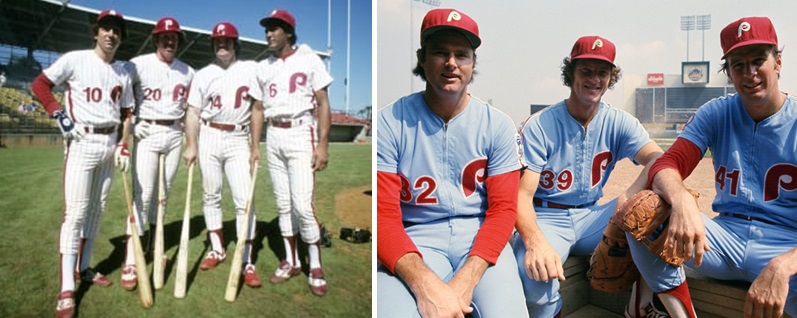
My passion for baseball and my hometown Philadelphia Phillies would begin at age nine at the start of the 1971 Major League Baseball season. The 1970’s marked the beginning years in my life-long relationship with the game and the decade would close with attending my first World Series in person.
I grew up in a typical South Philly rowhouse on a small street not far from Veterans Stadium. My hometown team, the Philadelphia Phillies, had moved into what was at that time a sparkling new state-of-the-art palace when I was just nine years old. It was then that I started following the team and became a fan of the game of baseball.
For the first few years the Phillies were a losing ball club. But my first few trips out to the new stadium (you cannot really refer to The Vet as a “ballpark”) were always fun times. The sights and sounds of both the game itself and around the stadium, the music, the food. It all made for great entertainment for a pre-teen kid.
At that point, I had no knowledge of the franchise history of futility. From their founding in 1883 through the 1974 season, 92 years of big-league baseball, the Fightin’ Phils had captured just two National League pennants. Since Major League Baseball had expanded and split into divisions in 1969, the Phillies had finished in either 5th or 6th place in the six-team NL East Division every year through 1973.
One of the few bright spots for the Phillies in those years was pitcher Steve Carlton. The big left-hander had arrived in a trade from Saint Louis just as spring training was getting underway prior to the 1972 season. “Lefty” would go on to win four NL Cy Young Awards here in Philadelphia and earn a place in the Baseball Hall of Fame.
When I entered my teenage years, things finally began to change for the better. A homegrown young core group of players was beginning to show their talent. That group included shortstop Larry Bowa, left fielder Greg Luzinski, catcher Bob Boone, and a supremely talented third baseman named Mike Schmidt.
The Phillies nearly reached the .500 mark in 1974, finishing at 80-82, and then in 1975 battled for the division lead most of the year. Finally for three straight seasons from 1976-78 the Phillies won the NL East Division crown. In both 1976 and 1977 they won a franchise-record 101 regular season games. However, each year they fell short of the ultimate goal, eliminated in three successive National League Championship Series.
After the 1978 season ended in yet another postseason disappointment, the club’s ownership stepped up and made their first big-money free agent signing, inking Pete Rose to a five-year deal. “Charlie Hustle” was aging but still appeared to have plenty of gas in the tank. He would prove to be worth every dollar spent by the club. But it would not happen right away.
With Rose added to their three-time NL East champion lineup the Phillies appeared favorites again in 1979. On May 17th they outslugged the host Chicago Cubs in a memorable 23-22 contest at Wrigley Field. That win left the Phils’ with a 24-10 record and already a 3.5 game lead. And then it all fell apart under the weight of nagging injuries and inconsistency.

Few were ready for the drama and excitement of the 1980 Philadelphia Phillies campaign. As fans, we were apprehensive about the team. Talented, sure. But could they regain the division crown? And if so, what was going to be any different this time around in the playoffs?
The ball club remained in the division battle right down to the end and a three-way battle for NL East supremacy unfolded in September between the Phillies, Pirates, and Montreal Expos. The Pirates would eventually fall behind and then fall apart over the final two weeks of the season. But the Phillies and Expos battled right down to the final weekend. There, on the road in Montreal, the Phils’ finally prevailed.
Favored entering the NLCS, the Phillies took Game 1 from Houston at The Vet. But the Astros stormed back to capture the next two games in extra innings. With their backs to the wall in what was then a best-of-five championship series, the Phils’ rallied late and then won Game 4 in 10 innings to even the series.
In the decisive Game 5 at the Astrodome, trailing the great Nolan Ryan by 5-2 entering the 8th inning, the Phillies miraculously rallied to take the lead. Houston kept battling and it took until the 10th once again before the Phillies finally, mercifully put an end to the years of postseason futility with a 7-5 win. It was the first National League pennant for the franchise in 30 years.
At this point, I was 18 years old, married, a father of an eight-month-old baby girl, living in a one-bedroom South Philly apartment, and working at a low-paying job with a local bank. I didn’t have two spare dollars to my name. But I sensed an opportunity.
The Phillies were making general admission tickets available for $15 each with fans permitted to purchase up to eight tickets to the scheduled Games 1 and 2 at Veterans Stadium. You read that correctly – $15 each. Compare that to the more than $1,100 per ticket that seats are going for right now on the secondary market for the coming Dodgers-Yankees Fall Classic.
However, in those days it was a lot of money for me to put out. And you had to go stand in line at The Vet box office. Remember, it was 1980. No computers. No internet. No StubHub. I went over to the ballpark and stood in line on the day of the sale. By the time I reached the box office, tickets were selling for Game 2. I plopped down $120 for eight tickets and walked away with what I hoped was a sound investment.

When I returned to work, I put out the word that I had World Series tickets for sale. It did not take long for the fish to take the bait. One bank executive offered me $50 each for a pair and said they knew another would do the same. Before my first day back at work was over, I had sold four of the tickets for $200 total. On the day of the game, I sold another pair for half that just to get rid of them. I had made $250 of my original $120 investment, a nice bump in my family ledger, and still had two tickets left for myself.
There would be a final wrinkle in my game plans. When I got home from work, I learned that my wife was unable to get the night off from her employer. I would have to scramble for a last-minute replacement. Now remember, this was October 1980. No internet, social media, cellphones, pagers, etc. The only ways to contact people were in person, over a landline telephone, or through the mail.
I quickly began to call around to no avail. My brother, father, and close friends were all not answering their home phones. I later found that most had either been still at work or on their way home. Finally, I called my cousin, who lived just a couple blocks away. My Uncle Frank answered, and said that my cousin was at work still, but that he would go if I wanted. And that is the story of how I attended my first ever World Series game in the company of my father’s sister’s husband.
Uncle Frank and I enjoyed a rollicking good time. The Vet was resplendent in red, white, and blue bunting. The huge crowd was boisterous. And the Phillies came through with a late rally to defeat Kansas City by a 6-4 to take a 2-0 lead in the World Series.
Six days later, on October 21, 1980, the Phillies would finally capture their first World Series crown, taking down the scrappy Royals in six games. And so, 44 years ago today, Phillies fans finally woke up to a world in which our team were the champions of Major League Baseball.
MORE articles on the 1980 World Series champion Philadelphia Phillies
8.13.22 – 1980 Philadelphia Phillies: Memorable and beloved
5.30.20 – Phillies champions: 1980 vs 2008
3.23.20 – Remembering Dallas Green
3.14.20 – 1980 Phillies pennant-winning mystery solved
11.29.16 – Rookies were unsung heroes of Phillies 1980 world champions
10.29.15 – Phillies Fall Classics: 1980 World Series Game 6
10.28.15 – Phillies Fall Classics: 1980 World Series Game 5
10.27.15 – Phillies Fall Classics: 1980 World Series Game 2
10.24.15 – Phillies Fall Classics: 1980 World Series Game 1
10.21.08 – Uncle Frank and I go to the World Series
 MATT VEASEY
One thought on “My 1970’s fandom road to the 1980 World Series”