
I was a nine-year-old growing up in South Philadelphia when Veterans Stadium opened less than two miles from our family home. That would mark the beginning of my lifetime spent closely following along as a huge fan of the Philadelphia Phillies.
In June of that year, the Phillies selected a 21-year-old shortstop out of the University of Ohio with their second-round draft pick. Michael Jack Schmidt would go on to become the greatest third baseman in the history of Major League Baseball and the greatest player in Phillies franchise history.
Schmidt would amass 548 home runs over an 18-year career. He was a 12x National League All-Star, 10x NL Gold Glove Award winner, and won the first five Silver Slugger Awards for NL third basemen once that award was created in 1980. He would win a half-dozen total.
In addition, Schmidt was the National League Most Valuable Player in 1980, 1981, and 1986. In that magical 1980 campaign he won the World Series MVP honors in leading the Phillies to the first championship in franchise history.
Schmidt was elected to the Baseball Hall of Fame in 1995, his first year of eligibility, having been named on 96.5% of the writer’s ballots.
During the entirety of Schmidt’s career, he was one of the most feared sluggers in the game. He produced 13 seasons of 30+ home runs. Three times he surpassed the 40-homer mark, including that first 1980 MVP campaign when he launched a club-record 48 longballs. That record would stand for more than a quarter-century until Ryan Howard blasted 58, setting the current club mark during his own 2006 NL MVP campaign.
There were many memorable home runs rocketed out of MLB ballparks by Schmidt during his time in the game. For instance, few here in Philly who were around at the time will ever forget his extra-innings blast in Montreal that gave the Phillies a dramatic win over the host Expos in a head-to-head battle for the NL East Division crown on the next-to-last day of that 1980 season.
Schmidt is one of just 18 players to go yard four times in a single MLB game. Amazingly, three of those were playing with the Phillies while they enjoyed their big days at the plate. All are Hall of Famers. None, including Schmidt, did it at home.
First was Ed Delahanty, who accomplished the feat on July 13, 1896, at West Side Grounds against the host Chicago Colts. Nearly 40 years to the day later, on July 10, 1936, Chuck Klein victimized the host Pittsburgh Pirates at Forbes Field.
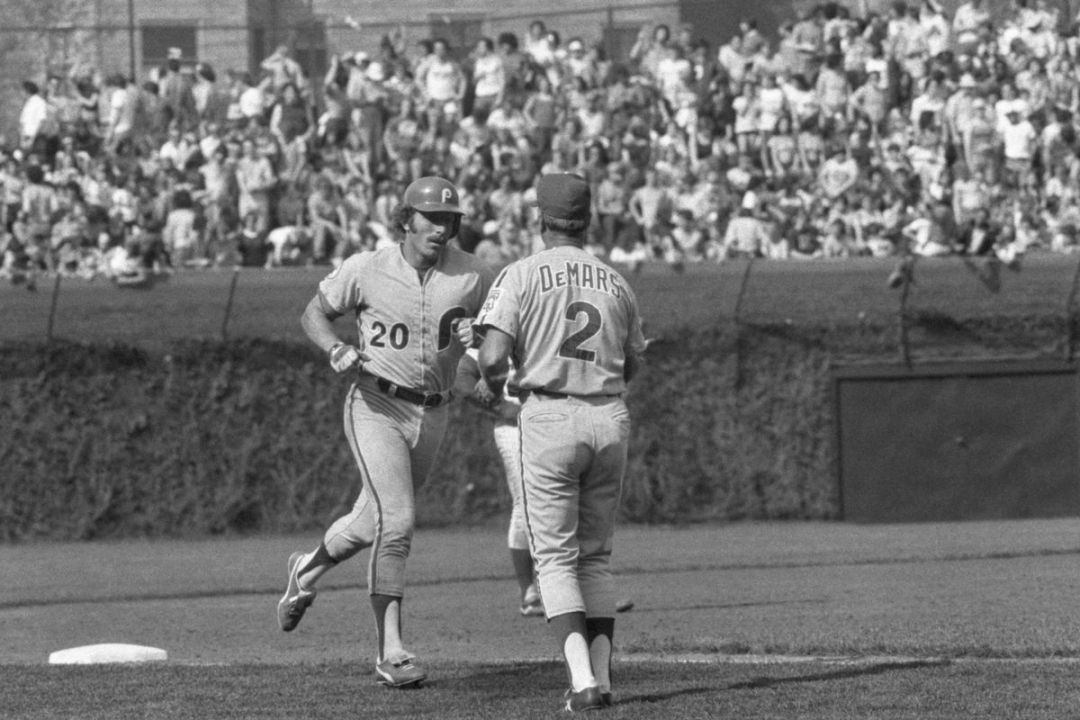
Yesterday was the 48th anniversary of Schmidt’s own memorable feat, a classic Wrigley Field slugfest in which his four home runs paced the Fightin’ Phils to an 18-16 victory over the host Chicago Cubs.
Let us look back at that game.
APRIL 17, 1976
The season was just a week old when the 1-3 Phillies arrived in Chicago for a quick two-game weekend set with the host Cubs. Mike Schmidt had already homered once, but he was as cold as the team, hitting just .167 with just three total hits over his first 21 plate appearances.
The pitching matchup that day did not appear to favor an offensive outburst. Future Hall of Famer Steve Carlton, a 31-year-old left-hander in his 12th big-league season, his fifth with the Phillies, would take the mound. His counterpart for Chicago was 26-year-old, five-year veteran right-hander Rick Reuschel. Neither would enjoy a banner day.
The Cubbies got to Carlton early, blowing him out of the contest in the 2nd inning with seven runs on seven hits. In the 3rd, the hosts failed to produce an exta-base hit, but still put five more runs on the board to up their lead to 12-1.
The two clubs traded runs in the 4th inning, but with a 13-2 lead, Reuschel appeared to be cruising. A doubleplay ball nearly got him out of a potential jam in the top of the 5th when, with two outs, Schmidt got his big day started, crushed a two-run homer completely out of Wrigley and onto Waveland Avenue. That made the score 13-4, and Reuschel and the Cubs would maintain that lead into the 7th inning.
The Phillies got a run back in the 7th making it 13-5 and, with two outs, Schmidt stepped to the plate once again. This time the third baseman drilled a line-drive two-run homer over the ivy-covered left field wall, cutting the deficit to 13-7. Reuschel would complete the inning, but it would be his last.
In the top of the 8th, reliever Mike Garman immediately got himself into big trouble. The righty surrendered hits to Bobby Tolan and Dave Cash and walked Larry Bowa to load the bases with nobody out. However, he followed that up by getting a shallow fly out and a strikeout, giving himself a shot to get out of the frame with no damage. It was not to be. Dick Allen singled to score Tolan and Cash, cutting the Phillies’ deficit to 13-9.
That brought Schmidt to the plate. Mike proceeded to crush a three-run bomb into the upper bleachers in right-center field, pulling the Phillies to within a single run at 13-12.
In the top of the 9th, the Phillies put three on the board to finally take a 15-13 lead. The Cubs had been held scoreless since amassing the early 13-2 lead. But the home team would tie it up on a two-out, two-run single by Steve Swisher off Tug McGraw.
Allen led off the top of the 10th inning with a walk, which brought Schmidty back up to the dish. For the fourth consecutive at-bat the Phillies slugger lifted a ball out of the yard. This one went just over the left-center field wall and dropped into the basket netting above the ivy for a 17-15 lead. A later run pushed the lead out to 18-15, and they would hold on for the win.
MORE BASEBALL
2.02.24 – Phillies 2024 pre-season top prospects
1.06.24 – The Phillies’ Bryce Harper Era
11.28.23 – Dan Baker deserves Phillies Wall of Fame honor
5.21.23 – A look back at Nolan Ryan’s seven career no-hitters
3.17.23 – Remembering Tug McGraw on Saint Patrick’s Day
 MATT VEASEY
6 thoughts on “Mike Schmidt’s four home run game”