
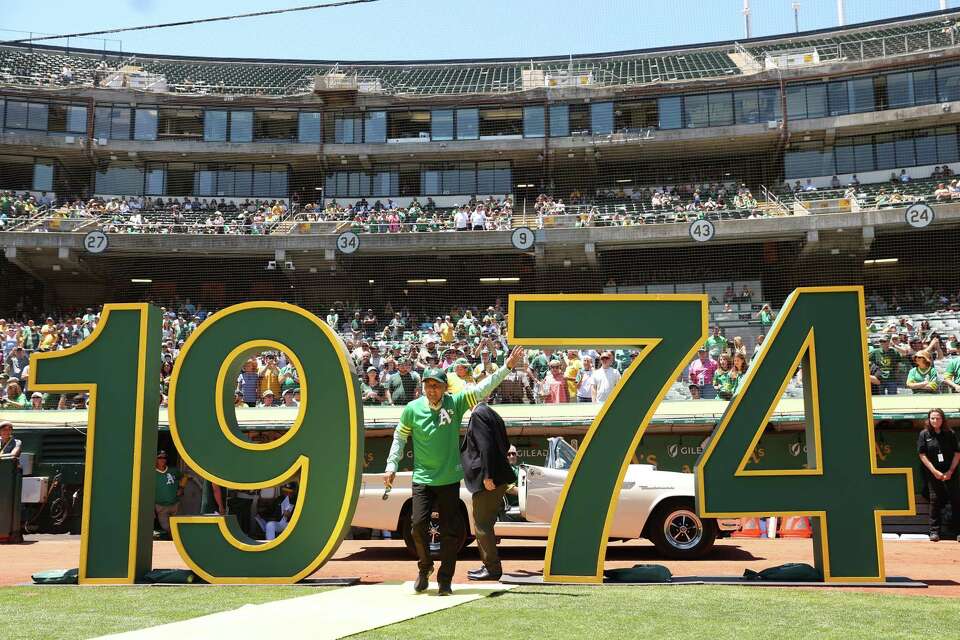
Take a ride with me in Mr. Peabody’s “Wayback Machine” to the year 1974. Under the weight of the Watergate investigation, Richard M. Nixon had resigned the office of President of the United States in August. “Here’s Lucy” was cancelled by the CBS network, bringing Lucille Ball’s legendary 23-year series television career to an end.
At the end of October, Muhammad Ali unveiled his “rope-a-dope” strategy to defeat the seemingly invincible George Foreman at the “Rumble in the Jungle” of Zaire, Africa, and recapture the undisputed heavyweight boxing championship of the world. Disco music was emerging from the club scene to mainstream radio, and by the end of the year, everybody was “Kung Fu Fighting” along with Carl Douglas.
In the 1974 Major League Baseball (MLB) season, Steve Garvey of the Los Angeles Dodgers and Jeff Burroughs of the Texas Rangers took home Most Valuable Player honors in the National and American Leagues, respectively. On the mound, reliever Mike Marshall of the Dodgers and future Hall of Famer Catfish Hunter of the Oakland Athletics won the National and American League Cy Young Awards.
Hunter and his Oakland Athletics ball club were the two-time defending World Series champions, the first repeat MLB champions in more than a decade and just the second in two decades. “The Swingin’ A’s,” as they had become known, were a beloved Oakland phenomenon.
The A’s were baseball’s most colorful team in many ways, including in the variety of uniform styles and colors that they wore on the field. Today, “alternate” uniforms are a novelty, used mostly as a way for teams to generate money by enticing fans to purchase more merchandise. For those early-mid 1970’s Oakland A’s, alternating uniforms were a daily fashion statement and a part of their brand.
Hunter won 25 games that year as the ace of a talented starting rotation. He was joined by two more big talents. Left-hander Vida Blue had won his own Cy Young and the AL Rookie of the Year Award three years earlier. Right-hander Ken Holtzman was an AL All-Star in both 1972 and 1973. Both Hunter and Holtzman were entering their career primes at age 28, while Blue was still only 24-years of age.
Those three and the five other men who took their arms to the mound to start a game that year for Oakland would produce a total of 49 complete games, with the ‘big three’ producing 44 of those. But when a game did need to be nailed down at the end, first-year manager Alvin Dark had future Hall of Fame right-hander Rollie Fingers to call upon.
Fingers had grown a mustache in 1972 and sculpted it into a beautiful handlebar style that became his signature. But it was his fastball-slider-forkball combo of pitches that consistently befuddled big-league hitters. At age 27, he saved 18 games that year of 1974 and would go on to embody the newly emerging closer role in baseball.
Dark’s starting lineup usually featured four big bats: third baseman Sal Bando, left fielder Joe Rudi, first baseman Gene Tenace, and future Hall of Fame right fielder Reggie Jackson. Playing between Rudi and Jackson was speedy 26-year-old Bill North, who manned center field and stole 54 bases.
Still a few years shy of earning his now-famous “Mr. October” nickname, the 28-year-old Jackson slashed .289/.391/.514 while leading the club with 29 home runs and stealing 25 bases in 1974. The reigning AL Most Valuable earned his fourth straight and fifth overall career AL All-Star honors as well.
Both the second base and catcher positions were largely platooned by Dark. The righty-hitting side of the second base platoon was 34-year-old Dick Green, the team’s most tenured player. Green was in his 12th and final big-league campaign. His career began in 1963 during the years when the ball club was in Kansas City. Sharing the keystone was switch-hitting Ted Kubiak, who had begun his career with the A’s during their final season in Kansas City in 1967. Kubiak was dealt away in 1970, but returned in 1972, just in time for the glory days.
The catchers were 27-year-old Ray Fosse and 31-year-old, eight-year veteran Larry Haney. Fosse won the AL Gold Glove Award behind the dish in both 1971 and 1972 while with Cleveland and was an AL All-Star each of those years. He had famously been plowed into by Pete Rose in a 12th-inning home plate collision that gave the National League the victory in the 1970 MLB All-Star Game. Haney won the World Series as a rookie with the 1966 Baltimore Orioles.
Veteran shortstop Bert Campaneris was in his 11th season. He traced his career back further than anyone but Green, to 1964 and those final Kansas City years for the Athletics. ‘Campy’ never won a Gold Glove or hit for much at the plate. But he was one of baseball’s most steady shortstops, and he had speed to burn. 1974 was his 10th straight with at least 30 stolen bases. He had topped the 50-steals mark six times, including as recently as 1972.
The franchise was owned by a maverick 56-year-old businessman named Charles O. Finley. “Charlie O” as he came to be known had tried and failed to purchase an MLB franchise a couple of times before finally succeeding with the Kansas City Athletics in December 1960. Four years later he had a deal to move the club to Louisville but was blocked by fellow owners. Finally in January of 1968 the team would relocate to Oakland.
Finley functioned as his own general manager with the Athletics, even when he had someone else formally hired to the job title. His eye for talent would prove so good that Hall of Fame baseball labor leader Marvin Miller said he was “absolutely the best judge of baseball talent I’ve ever seen.”
The 1974 Oakland Athletics got off to a cold start, still with a losing record as of May 10. Earlier that week they had dropped to fifth place of six teams in the American League West Division. But the club began to play better, and by May 19th they would take over first place for good. From July 1 onward the A’s went 49-37 and won the division by five games. It was their fourth of five consecutive AL West titles.
In those years, the playoffs were a simple matter. Win your division and you get to play for the league championship. To get to the World Series the A’s would have to get through AL East champions Baltimore. The Orioles entered the 1974 American League Championship Series with a veteran ball club led by 37-year-old future Hall of Fame third baseman Brooks Robinson. Veteran future Hall of Famer manager Earl Weaver had at his disposal a talented pitching staff that included 28-year-old future Hall of Fame righty Jim Palmer, the reigning AL Cy Young Award winner.
The Orioles went into Oakland and homered three times against Hunter to fashion a 6-3 win in the opening game of the best-of-five ALCS. But with their ace having been slapped around, the rest of the Oakland staff then picked him up. A’s pitching limited O’s hitters to a single run over the remainder of the series. Oakland swept to the AL pennant with 5-0, 1-0, and 2-1 victories, the last two in Baltimore.
Waiting in the World Series were the Los Angeles Dodgers. After finishing second in the NL West Division for four straight years, three times to Cincinnati’s early ‘Big Red Machine’ and once to San Francisco, the Dodgers had finally kicked down the door in 1974. It had taken an MLB-high 102 victories to hold off Cincy’s 98-win club.
In what was the first World Series conducted completely on the west coast, the two teams swapped 3-2 victories in the first two games at Dodger Stadium. That 3-2 final score would, in fact, be the exact same score in four of the five games. Unfortunately for the Dodgers, three of those four would be won by the Athletics.
The A’s went home to Oakland and swept out LA with 3-2, 5-2, and 3-2 victories. Fingers, who was the winning pitcher in the Fall Classic, earned a save in each of the final two. After setting LA down in order in the top of the 9th inning of the clincher, he was named series MVP. That historic final out came, fittingly, when Fingers enticed a light grounder from Von Joshue right back to himself, flipping to Tenace and setting off the celebration.
I say historic, because the 1972-74 Oakland Athletics became the first team since the New York Yankees dynastic run of five in a row from 1949-53 to pull off a three-peat. They would be the last until the 1998-2000 Yankees equaled it with their own trifecta.
It was 50 years ago that the Swingin’ A’s captured their third straight World Series. As the franchise prepares to move on once again, their enthusiastic longtime fans in the city of Oakland will always have memories of this great club to help carry them into the future.
And in that future, whatever hometown fans living in and around Sacramento, Las Vegas, or wherever the franchise ends up next will be hoping that their version of the Athletics can one day repeat what the team accomplished five times in Philadelphia and four in Oakland – win the World Series.
 MATT VEASEY
4 thoughts on “50th anniversary of the Swingin’ A’s trifecta”